

President Trump is adding a new 10 percent tariff on nearly all imports to the United States, following a Supreme Court ruling that overturned most of the levies imposed by the US government last year.
In an executive order signed Friday evening, Trump outlined a few exceptions, including imports of critical minerals, beef and fruits, cars, pharmaceuticals, and products from Canada or Mexico. The new tariffs will take effect on February 24, 2026.
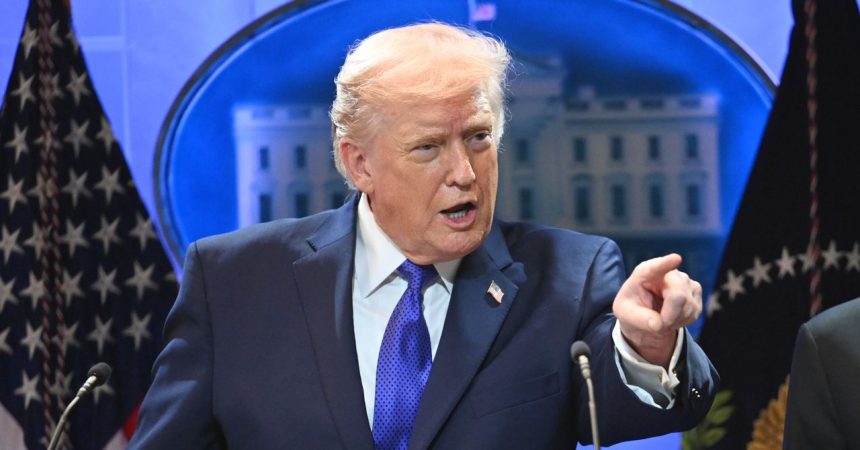
In a press conference Friday afternoon, Trump was fired up about the Supreme Court decision and resorted to personal attacks, calling the six justices who ruled against his trade policies “a disgrace to our nation.” Answering a reporter’s question about how two of the justices he nominated, Neil Gorsuch and Amy Coney Barrett, voted for the overturn, Trump called them “an embarrassment to their families.”
The new trade policy is based on Section 122 of the Trade Act of 1974, which allows the president to single-handedly and immediately charge tariffs of up to 15 percent if there are “large and serious” trade deficits. These tariffs only last 150 days unless Congress authorizes an extension. Like the International Emergency Economic Powers Act (IEEPA), the statute has never before been used by a US president in this way.
Once the 150-day deadline arrives, it’s possible for Trump to keep reissuing Section 122 tariffs. But the administration could also use this time to prepare other forms of tariffs, essentially switching legal justifications to get the same regulatory effects, says Gregory Husisian, a partner and litigation attorney at Foley & Lardner LLP, which has helped over a hundred companies file requests for tariff refunds. “[Section 122 tariff] is for a limited time period, so it’s going to be a bridge authority,” Husisian says.
In the meantime, the Trump administration could rush through the process of conducting trade investigations based on concerns of national security or unfair trade practices abroad, which are a requirement for launching Section 301 and Section 232 tariffs. “We are also initiating several Section 301 and other investigations to protect our country from unfair trade practices of other countries and companies,” Trump said at the press conference, referring to these other tariff options that take longer to launch.
In a separate executive order, the administration confirmed that despite IEEPA tariffs being overturned, the de minimis exemption—which is used to exempt ecommerce packages under $800 in value from being taxed—remains suspended. The end of de minimis last year caused massive package processing backlogs at the US border as well as price increases on budget shopping platforms.
At the press conference, Trump didn’t specify what exactly would happen to companies seeking refunds on their tariff payments. The Supreme Court decision did not specify whether and how the tariffs should be refunded. Answering a reporter’s question on the topic, Trump said he expected the issue to be litigated in court.
Experts tell WIRED that they expect the refund process to be messy and long, since it might require companies to file complaints and calculate the amount of money they believe they are entitled to receive. The government could also then push back on the calculated amount. The process could last anywhere from a few months to more than two years.
The Supreme Court decision specified that the IEEPA gives the president significant power during emergencies, but noted this power doesn’t extend to taxation. Trump, at the press conference, repeatedly distorted the ruling: “But now the court has given me the unquestioned right to ban all sorts of things from coming into our country, to destroy foreign countries … but not the right to charge a fee,” he said. “How crazy is that?”
At times, the press conference turned into a rant about issues unrelated to tariffs, like how the president thinks Europe is too woke or how much he hates the Federal Reserve chair Jerome Powell. Speaking about how the court interprets the literal meaning of the IEEPA, Trump suddenly started bragging about his reading comprehension skills. “I read the paragraphs. I read very well. Great comprehension,” he said.
Read the full article here