

Affiliate marketing has grown up. The new report from impact.com breaks down the five pillars of partner sophistication, shows how top teams measure creator performance with precision, and explains what actually drives revenue beyond the first click. Read the report.
Why settle for prestige beauty products when the hunt for an easier-on-the-wallet dupe can be a thrill?
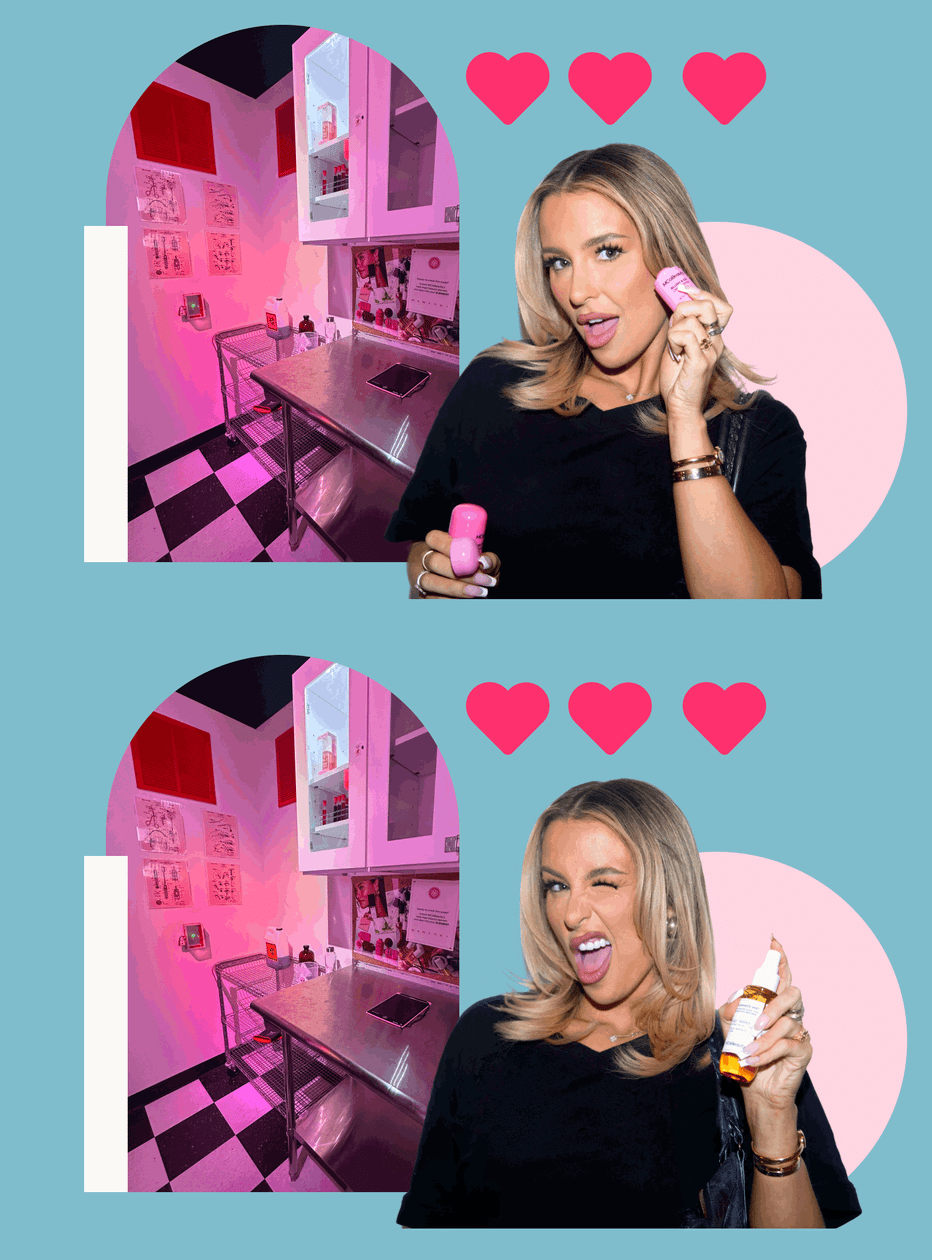
That’s the premise powering MCoBeauty’s latest campaign and entertainment-driven activation. The effort, called “If You Know, You MCo” (or IYKYMCo for short) includes a seven-episode microdrama social series starring Tana Mongeau, in which the creator gets locked in a pink, lab-like room somewhere in MCoBeauty’s offices that requires beauty-themed puzzle-solving to escape. Audiences who wish they were there IRL can get involved, too: at 30 Escapology locations nationwide, MCoBeauty has set up real-life beauty lab escape rooms for guests, complete with free product giveaways.
Together, the series and in-person games are meant to create a more tangible brand world, according to Meridith Rojas, CMO at VidaCorp, MCoBeauty’s parent company.
“You’ve heard a lot of brands talk about community, community, community, and how do you bring them into your marketing campaigns,” Rojas told Marketing Brew. “How do you bring them into feeling more part of it, and not just [saying], ‘lean back, watch something,’ or trying to hawk them products? Instead, we wanted them to feel immersed in this world that we are creating.”
A whole new world
MCoBeauty is well-known in Australia, according to Rojas, but in the year and a half since coming to the US, the brand has cooked up a few notable efforts designed to boost awareness, including a placement on the popular reality series The Secret Lives of Mormon Wives and an NYC shopping pop-up that unashamedly borrowed from Sephora’s signature aesthetic. These moments have been brand experiments to discover how to best connect to audiences, Rojas said, and the microdrama-meets-escape-room campaign marks the next phase of that effort.
“Anyone can buy media, anyone can buy eyeballs, but you can’t buy someone’s interest,” Rojas said. “That has to be earned, and that is so much more important, and that actually is more indicative of their desire to have a relationship to the brand.”
One important piece of bringing the escape room to life was finding a partner. Escapology rose to the top due to it having locations nationwide, which Rojas said allowed for broad community building that wasn’t confined to more typical markets like New York or LA. Escapology’s work with MCoBeauty is the first time the escape room company has partnered with a consumer goods brand, according to the company.
“We find our events to be such an effective way [to land our message], but I think the only pain point was, how do you scale events?” Rojas said. “Being in one city isn’t actually truly a community activation—it actually feels pretty isolated.”
Pairing that wider IRL access with the microdrama series—a format that several brands are experimenting with, and which Rojas believes is only in its beginning stages of popularity—will ideally create a full entertainment experience for viewers and customers.
Part of being a marketer today is to think like an entertainment executive, she said.
“We have to hook them with something that seems like they have to get to the end of that 60 seconds…and then at the end of that, we’re going to want them to go find the second episode,” Rojas said. “If we can do that, that’s a game changer, and [with] this microdrama series, we might go into Season 2 and 3.”
Dupe it
As MCoBeauty looks to its future in the US market, Rojas said it has a solid foundation in its identity as a dupe brand, a category that only continues to grow with customers and investors.
“We are a proud brand that dupes,” Rojas said. “We don’t shy away from that. We own that.”
MCoBeauty doesn’t name the prestige beauty products it aims to dupe, but the brand seems to drop clues to customers through packaging that mimics pricier counterpoints. “There are certain things that we have to respect in terms of how we frame it,” Rojas noted, “and so I think the reason we’ve been able to grow the way we’ve grown is that we follow the legal rules of the game.” It’s a strategy that she believes sets it apart from other dupe brands that have yet to do it “as boldly as MCo,” as she put it.
Being a loud-and-proud dupe brand isn’t always positively received, but Rojas said there’s been an increase in “masstige” beauty brands, which has helped shift perception.
“‘Dupe’ was a dirty word for a long time,” Rojas said. “[Now] it’s like the status-symbol death slash the era of gatekeeping is going away, and people see that telling their friends or followers that you can get a better deal is actually social currency. It’s nothing to be ashamed of… but it’s kind of our whole thing.”
Read the full article here